More here: https://www.abc.net.au/news/2024-01-10/living-funerals-celebrating-a-life-and-acknowledging-death/103249754
Monday, 26 February 2024
Sunday, 21 January 2024
Care in flight
Three times in the 5 months that we've been in Tea Tree Cottage we've heard the sound of the Westpac CareFlight helicopter descending nearby.

It's reassuring to think that this level of care is available to people living and working in regional areas when they need it. I always find myself saying a silent prayer for the sick or injured people it carries, those who operate it, and the people who will care for the patients when they arrive at a hospital.
It's reassuring to think that this level of care is available to people living and working in regional areas when they need it. I always find myself saying a silent prayer for the sick or injured people it carries, those who operate it, and the people who will care for the patients when they arrive at a hospital.
Wednesday, 10 January 2024

Tuesday, 9 January 2024
Rodeo
With my liberal, citified, vegan/cruelty-free sensibilities, I'd naively managed to assume that all rodeo activities would be creature-friendly. I don't quite know what I'd imagined this would look like - the cattle being calmly petted, perhaps?
The reality was very different. I found it rough to the point of violence, and spent most of my time averting my eyes. But when I could bring myself to watch, I took photos: bearing witness to what I saw.

Monday, 8 January 2024
Coffee and scones
One of the greatest attractions of the country town where we found Tea Tree Cottage was the fact that one of my siblings and their children lived there.
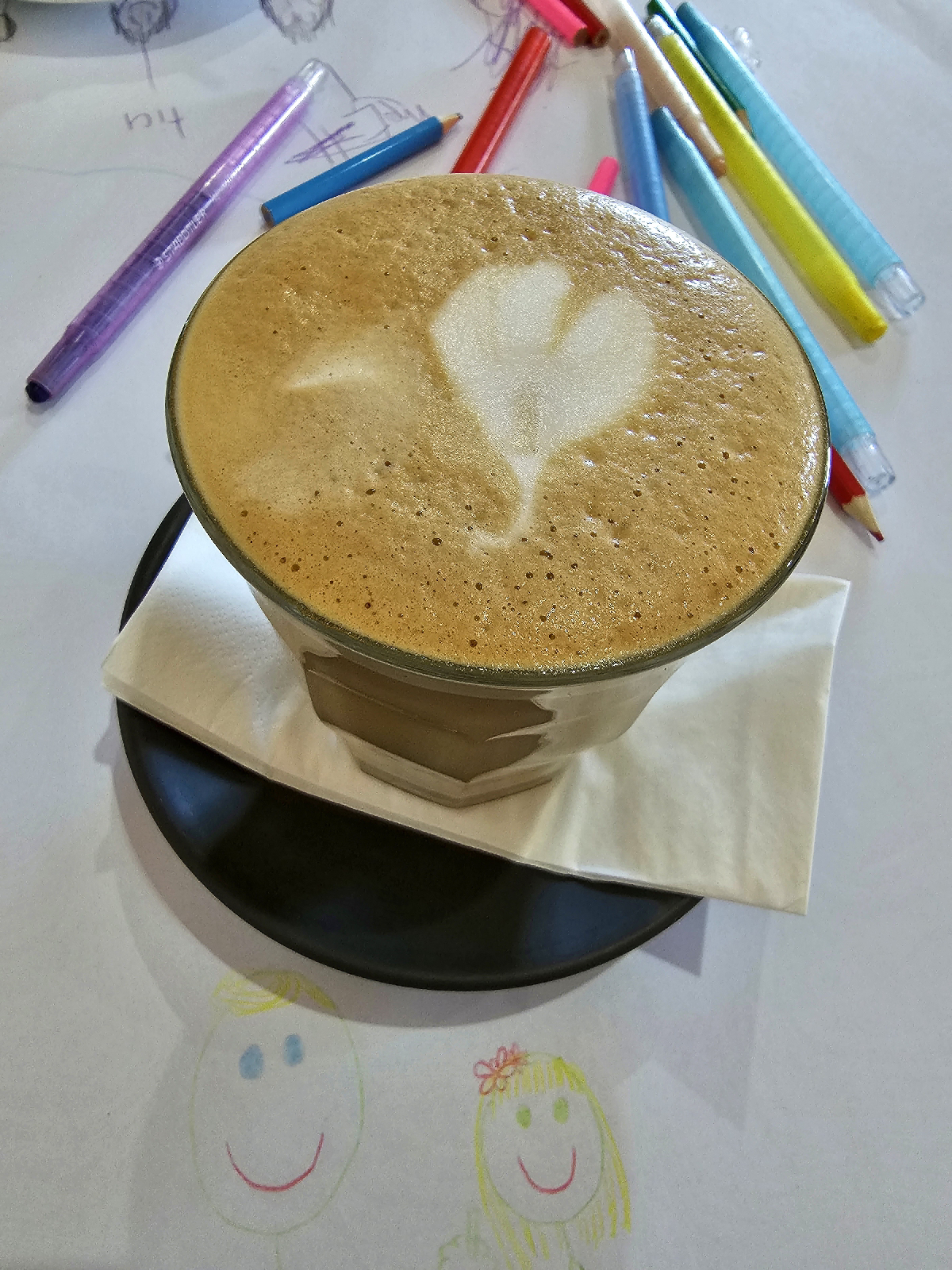

Amid the jumble of working out what needs to be done to the house, priorities, and how to source everything that would be needed to do it up, we find time for family outings. A nearby coffee shop offers tables covered with white paper and a supply of pens and crayons with which to decorate it ... As well as excellent coffee and fresh scones.
Sunday, 7 January 2024
Chaos
For the first few weeks of our tenure of Tea Tree Cottage, all is chaos and wonder. The internet takes a couple of weeks to connect, despite being organised weeks in advance, as there would be three of us working from home.
It's our first taste of the patience and innovation that would be required while living in a tiny country town. Equipment that couldn't be found in town needed to be ordered online and would take at least a week or 10 days to arrive; the alternatives were typically driving a couple of hours to a larger town, a 7-hour return trip to Sydney, or waiting for the next visitor willing and able to bring supplies up with them.
A few days after the internet was finally up and running, my phone died with no notice. With it I lost all my first photos of the Cottage.
Saturday, 6 January 2024
The Tea Tree Cottage Adventure
A few months ago we decided to throw caution to the wind and buy a little house in a small country town a few hours out of Sydney.
From the outside, the house doesn't look like much more than a glorified tin shed, being made almost entirely out of corrugated iron. Its little plot of land, just over 600sqm, holds a couple of trees and some sad-looking moruya shrubs.
But after over a decade of living in a tiny apartment, as we opened the front door it felt like a dream come true.
In weeks to come, we'd christen the tiny house Tea Tree Cottage. And as we opened that door, the Tea Tree Cottage Adventure began.
Friday, 5 January 2024

Thursday, 4 January 2024

Wednesday, 3 January 2024

Friday, 29 December 2023

Thursday, 28 December 2023

Monday, 30 March 2020

Tuesday, 17 December 2019
Melbourne
I was in Melbourne recently - work, the usual thing - days packed from dawn 'til dusk with meetings, and preparation for meetings, and actions following meetings. Late one night I tossed exhaustion and responsibility to one side to claim a sweet dark half hour for myself, and went wandering down Bourke Street mall to look at the Christmas decorations. They were perfectly pleasant, but it was on the walk back to the hotel that I happened across one of those scenes that are only ever found by chance - a man busking, making music from junk.
True junk - his instruments comprised an old oil tin, a saucepan lid screwed to a stand, a used plastic container of some description, a variety of empty and de-labelled tins (somehow that detail seemed important). He was drumming away upon them as if his very life depended upon it, generating a cheerful cacophony.
Nearby stood a small knot of young-ish people, probably drunk-ish, dancing like happy puppets to the noise. Whenever a passer-by paused to drop a coin into the busker's cap, the puppets would cheer and enthusiastically high-five the donor. Whether this was an incentive to donate or not was hard to tell.
A little further back, perched on the stone curlicue of one of the gates of Chinatown, was a couple. Stoned without a doubt, and in the process of becoming stonier still, they sat contentedly on one another, gazing blankly into space, air-drumming to the beat.
This is not a story, of course - just an observational piece recording one of those scenes which made my heart swell with love for the beautiful oddness of humanity, and the cities which draws them together in concentrated doses. Amid many more dark hours of work and responsibility, the memory of that bright street and that mad noise held its glow.
Friday, 20 September 2019
This is why I strike
If you are appalled that school children
are missing school to attend the climate strike today, you are not alone. I am
appalled. But I am appalled because those who birthed those children, who are
raising them, who collectively share reponsibility for keeping them safe - are
so blind to the most significant issue of our time – likely of all time – that
they they didn’t strike first, and indeed for the most part are not striking at
all. Instead, they are leaving leadership on this issue to their children, who
take action so they do not have to fear for their future.
So that they don’t have to fear for a future in which which water
shortages become more frequent and severe. In which refugees become greater in
number. In which mental health deteriorates. In which refugees grow in number
as they flee areas where water has become so scarce that they are no longer
able to inhabit them. In which conflict increases, as habitable land diminishes
and displaced people struggle to find somewhere to call home. In which huge
swathes of the weird and wonderful creatures we share this bit of space rock
with have gone extinct, never to be seen again – and in some cases, never to be
seen at all.[i]
If you think this sounds dramatic, it is
already happening. The US Department of Defence is already planning for a
future in which conflict as a result of climate change increases significantly.[ii]
The President of Kiribati, after years of
advocating for change to protect his small island nation, has bought 100 acres
of land in Fiji, so that when the now apparently inevitable time comes that his
people have to abandon their home as a result of the sea level rise which is
already impacting them, they have somewhere to go. He worries about the impact
this will have on his people, whose identity is intertwined with their land –
and how they will negotiate a Kiribati identity in a foreign land.[iii]
Traditional owners of lands in Samoa and
Tonga, whose cultures, stories, traditions have grown up around the patterns of
the world around them – are finding that these stories, rooted deep in time,
are out of kilter with changing weather patterns, and the resulting changes to
behaviour of plants and animals. Doesn’t sound like much, until you learn that
these changing patterns of behaviour are already impacting production of fruits
and other plants which we all eat – including the creatures we eat – rely on
pollination by insects, birds and seasonal winds.
For the most part, in urban Australia, we
are fairly well insulated from impacts such as these, so they, and the climate
changes which are producing them, are easy to dismiss. But the lived experience
of those in rural areas shows that our wide brown land is already being hit hard.
Many parts of NSW are experiencing the most severe drought on record. The
results of this have already been catastrophic for many. Mass fish deaths, the
shooting of thousands of head of sheep by landowners with no other choice,
people leaving farms which have been in their families for generations, loss of
precious topsoil no longer held in place by grass lond dead due to the drought
is swept away by windstorms, suicide by those who cannot bear these changes and
their impacts any more.
While for those of us in urban Australia
the greatest impact most of us have personally experienced is a slight increase
to our milk prices, beyond the urban fringe the impacts are such that within 50
years Dubbo will be a town set in the midst of desert.
To those who say that the response we should be making to
this situation is to recycle, catch public transport, and so on - I, and many, many others like me, have been doing this for years. I
recycle - but Australia's recycling crisis makes it doubtful that
thoserecycalabes will in fact be recycled. I try to take public transport -but
Sydney's woeful public tranport system makes this often impractical and
sometimes unsafe. I water my garden with grey water from my kitchen and shower.
I buy the ethical choices when I’m shopping. I, and the many, many others like
me, have done these things, and all the other things one is
"supposed" to do - the little things which collectively are supposed
to produce the necessary change. They are not enough.
Unlike many, I have had the privilege of
leading an environmental education organisation; I now work with another in
which care for our common home is integral to its work; I am fortunate to be
able to work with like-minded others in similar organisations in this space.
It is not enough.
We need urgent society-scale change.
The efforts of individuals, NGOs, and even
many business enterprises,[iv] are not enough to get the
job done. The change we need now needs to happen in, and come from, the top. It
needs to come from our government. And this change can only be accomplished
with votes and/or the weight of public opinion.
Our last federal election showed how little
confidence we should have in the electoral process to produce the necessary
change. We have a Prime Minister who, before assuming his current role, attracted
global notoriety for bringing a lump of coal into parliament and joking about
how there was no need to be scared of it. It came as no surprise that his
government continued to support the advancement of the Adani mine, with its
promise of being one of the biggest fossil fuel extractors in the world when up
and running. With some time until the next election, votes, for the purposes of
now, are out.
This leaves the weight of public opinion.
Well-planned civil disobedience typically follows a hierarchy, in which each
new level of disobedience is embarked upon when action at the previous level
has failed to achieve the sought-for result.
People who have been alert to the situation
we are in have been signing petitions and lobbying politicians and educating
children for years – decades now. All these years of lobbying have made no
difference, except that the situation has continued to worsen. And so today we
step up a level on the hierarchy of civil disobedience. To one which speaks of
disruption – to one which speaks to those who talk only money in economic cost,
the only language they seem to understand. Those in power should be paying
attention. The people they govern are becoming increasingly desperate in the
face of their governments’ failure to act.
If you're saying that the children who are
skipping school today would better serve this crisis by finishing their
educations and growing up to make a difference – we don’t have time. Without
dramatic society-wide change, in 12 years the climate will have changed, and
with that all the consequences we know about, and likely others we haven’t
thought of, will come to pass. The lives millions of fellow creatures whose lives
are being, and will be lost, through these changes at increasing rates, taking
with them their unique genetic codes, the results of millons of years of
evolution, as a result of our action and inaction. No matter how sophistcated
our cloning etc gets, the damage will already have been done. We will not be
able to recreate the Eden into which we and our children were born.
The only answer is action. And the time for
that action is now. The people who should be taking it are the adults – the
mothers, fathers, grandparents, aunts and uncles, the teachers of today. But in
the face of their inaction, the children are stepping in. And in my first act
of civil disobedience, so am I.
Monday, 18 June 2018
The Dunfanaghy Workhouse
Dunfanaghy is a small town on the north-west coast of
Ireland. To me it seemed to combine all the best elements of the world so far –
mountains like Switzerland, moors like Yorkshire, and a quiet coastal fishing
village which reminded me of Gerroa, a town on the coast south of Sydney, where
I spent summer holidays with my family when I was small.
The Dunfanaghy
Workhouse was the reason for my visit here. Built in 1842, a couple of the
original buildings still remain and have been converted into an exhibition which
tells the story of the workhouse’s construction and original use.
Workhouses have been built across Britain and Ireland from
the 1600s, places where those unable to support themselves found work, food and
a roof over their heads. They must have been desperately miserable places, as
they were deliberately designed to give the poor what they needed and not an
iota more – and that goes for their morale just as much as their material
needs. Indeed, there appeared to be an emphasis on ensuring workhouses were
dreary places, so that only the most desperate would seek refuge there, and
leave as soon as they were able.
At Dunfanaghy, the workhouse consisted of separate buildings
and yards for men, women, boys and girls (families were split up in the workhouse,
but parents were able to see their children; however they weren’t able to leave
except as a unit, making it impossible for, say, the man of the house to leave
his family in comparative safety while he sought work). There was also a fever
hospital, infirmary and a main building housing dormitories, day rooms, a
workshop and school room.
Children were expected to spend 3 hours a day in the workhouse school, while adults spent most of their time working – the women undertaking all the domestic chores of the workhouse and making clothes and bedding, while the men typically had a choice between breaking stones for road construction or oakum picking (separating the fibres of old ropes for use as caulking on ships).
 |
| Model of Dunfanaghy Workhouse in its heyday |
Children were expected to spend 3 hours a day in the workhouse school, while adults spent most of their time working – the women undertaking all the domestic chores of the workhouse and making clothes and bedding, while the men typically had a choice between breaking stones for road construction or oakum picking (separating the fibres of old ropes for use as caulking on ships).
In 1845, the daily rations for adults and children over 13
comprised:
- 170g oatmeal and 378ml buttermilk for breakfast
- 1.3kg potatoes and 378ml buttermilk for dinner
- 140g oatmeal and 378 ml buttermilk for supper
Monday, 11 June 2018
Back to Ireland: the Rock of Doon
Well my friends, we took a little hiatus while I returned home,
to work, to my normal life. However a rainy long weekend beckons, and it seemed
a good time to return to Ireland …
When last we met we were in Sligo, at the grave of W B
Yeats, found by the first of two happy accidents in a single day. The second such
happy accident occurred along similar lines, with a well-placed road and a
just-glimpsed road sign along the way. This time it was the Rock of Doon that I
found myself a couple of kilometres from, and gladly diverting for.
The Rock was, in ancient times, the coronation-place of the
O’Neills, chieftains of Donegal and Ulster, and I’d long wanted to visit it. A
short climb up a paved footpath brought me to the top of the Rock, where a
glowery day looked down on me, and the sounds of farms and forestry made this
place of Celtic history, with all the ghosts of the legends I’d read about it,
seem rather ordinary really.
At the foot of the rock is a holy well. This one was said to
cure afflictions of the feet, and beside it a couple of nearly leafless small
bushes were weighed down by the tokens brought as offerings by the hopeful.
Rosary beads, crucifixes in metal and wood, socks upon socks upon socks, and an
empty cardboard medicine box.
 |
| Offerings at Doon Well |
The well itself was housed neatly in a little stone house
with well-made wooden doors, and the stations (the prayers which it was believed
had to be said to bring on a miracle) inscribed in the stone of the roof. Two
plastic measuring jugs sat tidily to one side, filled with water from the well.
I glanced up – a couple of houses sat not far off. I liked to think that
someone who lived in one of them perhaps made it their job to keep the well
ready for visitors.
 |
| Doon Well - doors closed ... |
 |
| ... and open. |
Saturday, 26 May 2018
On the edge of possibilities
There’s something rather bewitching about teetering on the precipice
of a delicious possibility – so close to it that you can nearly – nearly – touch it, in all its dreamy perfection, but not so close that you can see the
disillusionment which is certain to become apparent the moment you give way to that
gravity-like force of all delightful possibilities (pulling you to themselves
with their inviting fingers) …
Friday, 4 May 2018
The Connemara Mountains, laundry and grave-tending
I slept in the Connemara Mountains that night, in a Gaeltacht (an area of
Ireland where Gaelic is routinely spoken and actively promoted – if you’re ever
in the mood for a brainteaser, I recommend that you try figuring out what
recycling goes into which bin when they’re all labelled with Gaelic and nothing
else).
The next morning, after washing my socks in an icy lake (I
pinned them under rocks in a little inlet and let the waves do most of the
work), I continued on to Donegal, and having two happy accidents on the way.
The first was seeing the grave of W B Yeats, which I’d hoped to visit but
thought I’d run out of time, so was quite delighted to find myself reading a
sign pointing me to a beautiful old church by the road in County Sligo. The
cemetery wasn’t his original burial-place (Yeats died in France during World
War II), but it was an ideal place for a man with a deep love of Sligo to end
up – in sight of mountains and fields, surrounded by trees and birds, and with
sunlight slanting through the trees. As I left, I noticed an old man carefully
removing a twig from a grave which was already meticulous. It bore a woman’s
name, and a date of decease from 2009 – his wife, I imagined, as he gently
walked up and down across the gravel which covered it, making sure everything
was in perfect order.
 |
| Laundry day. |
Thursday, 3 May 2018
Aran Islands: goats' cheese
The long walk back to the ferry at
Kilronan was fortunately broken when I came across the farm which had produced
the fresh goat’s cheese I’d enjoyed at breakfast, and I was delighted to find
they had a beautifully set up visitor’s centre – complete with educational
displays and large windows through which you could watch the cheese being made.
It was fascinating to learn that the young family which started the farm came
up with the idea when the husband got tired of spending 10 months of each year
away from his wife and small children on fishing trawlers. After some research,
they decided to build their goat farm, and from all accounts it’s a great
success, with the goats thriving on the wonderful mix of herbs, grasses and
other plants which grow naturally on the island. Keen to buy some cheese for my
supper, I particularly wanted to try one they made with dillisk, a seaweed
grown and collected on the island. They didn’t have any in stock, so the farmer
whipped round the back and made some for me – can’t get fresher than that!
A couple of hours later, back on the mainland and heading for Donegal, I
stopped in the midst of the breathtaking Connemarra mountains and ate my
dillisk goats cheese on fresh, crispy bread. Sitting there, in the clear wild
air, I felt a wordless grace forming – images of thanksgiving for the land, and
the goats, the grain, the sea, the dillisk, and the hands which together
brought these things together to nourish me on my journey.
 |
| Fresh dillisk goats' cheese. |
Subscribe to:
Posts (Atom)